

ROA – Return on Assets is a financial ratio expressed as a percentage. It reflects the profitability of all assets. In other words, it shows what percentage of profit is generated from the total assets managed by the company. Sometimes, it is also referred to as the return on total capital (since equity + debt = total assets).
ROA – Return on Assets: Definition and Formula
ROA measures how efficiently a company uses its assets and how much profit these assets generate. Each company has a different asset structure and total asset value (balance sheet total). The financing structure (debt vs. equity) also varies.1 2
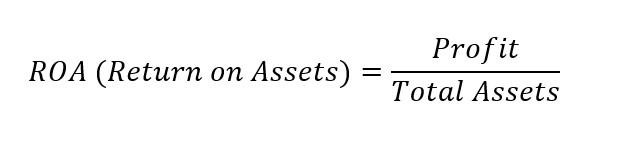
The higher the ROA, the more profit is generated per unit of asset. Depending on which profit measure is used in the numerator, the results can vary significantly.
ROA Interpretation – Different Situations
Typical healthy ROA values differ widely across industries and company sizes. Benchmarking is important. ROA should be interpreted in the context of other financial ratios. For instance, high ROA values are more common in small or medium growth companies that are leveraged with investments and debt, whereas large, established firms may have lower but more stable ROA due to conservative management.
Key points regarding ROA interpretation:
- Low ROA is not necessarily negative. It may indicate a conservative company with a low-risk profile that holds financial reserves and manages assets cautiously. Alternatively, it could indicate a company that is hesitant to invest or innovate. Excessive risk aversion (underutilization of financial leverage or holding non-productive assets) can hinder growth and lead to loss of market position.
- Low ROA can result from inefficient use of assets. Are some assets tied up unnecessarily? Are inventories held too long? How efficient is the supply chain and procurement process? What is the overall asset utilization efficiency – activity ratios? These closely relate to ROA.
- Very high ROA can indicate excellent asset management, but it may also reveal risks, one-off effects, or liquidity issues.
- It is recommended to compare ROA to industry benchmarks to evaluate asset efficiency against the market.
- Trend analysis (horizontal evaluation) is valuable to assess ROA dynamics over time, often providing more insight than a single-year value.
- Risk profiles vary by industry. Expected returns should match business risk, and ROA must be interpreted accordingly.
- Some companies carry high debt. Unlike ROE, ROA includes debt in the denominator, but neither ratio reflects risk fully. Therefore, ROA should be interpreted together with leverage ratios.
ROA should not fluctuate dramatically from year to year. Significant changes should be analyzed and explained. Common reasons include:
- One-off items unrelated to core operations, which may require adjusting the numerator or denominator.
- Changes in total assets or profits, which need further investigation.
- High volatility in small, rapidly growing (or declining) firms, where multiple drivers affect ROA.
DuPont decomposition can help explain ROA structure and its drivers.
Profit Definition in ROA Calculation
As with ROE, the choice of numerator affects ROA results:
- EAT (Net Profit After Tax)
- EBT (Earnings Before Tax)
- EBIT (Earnings Before Interest and Taxes)
- EBITDA
The selected profit measure determines what ROA represents.
For companies with significant debt (operating or investment loans), ROA includes debt in the denominator, but the numerator may exclude financial costs (EBIT or EBITDA). The choice depends on the intended perspective:
- EBIT – measures returns for creditors, the state, and owners.
- EBT – measures returns for owners and the state.
- EAT – measures returns only for owners.
How to Improve ROA (and other profitability ratios)
ROA can be increased by either:
- Increasing profit with the same level of assets – using existing resources more efficiently.
- Reducing assets with the same profit level – disposing of non-productive assets.
In other words, either reduce asset requirements for the same profit generation or increase profit for the same asset base. Profit can be influenced by operational performance or one-off factors. Analysts may adjust ROA for one-off effects if relevant.
Reference
- Investopedia, Return on assets [online]. [cit. 2025-10-29]. Available at: https://www.investopedia.com/terms/r/returnonassets.asp
- Wikipedia, Return on assets [online]. [cit. 2025-10-29]. Available at: https://en.wikipedia.org/wiki/Return_on_assets