

When you work with SQL database you usually need more than 1 table. Some values are in one table and the others are in a different one = distribution of data into many tables which are connected between each other (via keys) is the principle of relational database.
There are 5 basic kinds of joins: INNER JOIN (this article), LEFT JOIN, RIGHT JOIN, CROSS JOIN, FULL JOIN. Commands INNER JOIN and JOIN are equivalent
Now or later you will need to know how to connect the tables. Let’s learn it!
INNER JOIN Syntax
SELECT
[Table_A].[Column 1]
,[Table_A].[Column 2]
,[Table_B].[Column 3]
FROM [Table_A]
INNER JOIN [Table_B]
ON [Table_A].[Id] = [Table_B].[Id]
To make it easier, imagine 2 tables. Each of the tables will consist of only 1 column [Number]:
- Table A consists of column [Number]: 1, 2, 3, 4, 5, 6, 7, 8, 9, 10
- Table B consists of column [Number]: 1, 2, 3, 100, 150
What will be the result of the script?
SELECT

[Table_A].[Number], [Table_B].[Number]

FROM [Table_A]

     INNER JOIN [Table_B]

       ON [Table_A].[Number] = [Table_B].[Number];
The result is only 3 rows:

Hint: Take a look at the examples of all the possible kinds of connections of the tables to better understand the differences between each kind (see other articles). I always use the same example – football teams.
INNER JOIN Example – Football teams
We will take a look at the database table joins using football teams. We have 2 tables, take a look at them (sorry, texts in screenshots and object names are in Czech):
- [Fotbalove_tymy] ([ID], [Tym], [Id_mesto]) – table with list of the football teams
- [Mesta] ([ID], [Nazev_mesta]) – table with towns
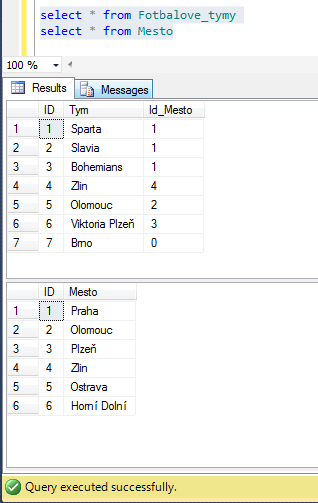
The task is to display the list of the football teams with their hometown. Script will look like this:
SELECT
[Fotbalove_tymy].[ID]
,[Fotbalove_tymy].[Tym]
,[Mesto].[Mesto]
FROM [Fotbalove_tymy]
INNER JOIN [Mesto]
ON [Fotbalove_tymy].[Id_Mesto] = [Mesto.Id];
We create a relation between the tables. The condition by which both records from the table will get connected lies in ON clause ([Fotbalove_tymy].[Id_Mesto] = [Mesto.Id]).
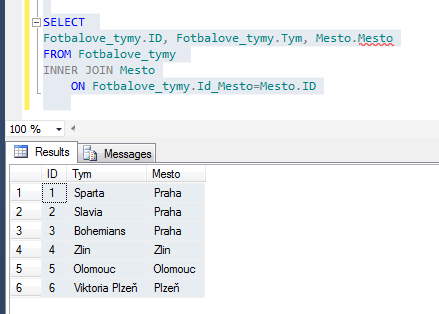
Result after applying inner join
Evaluation: We miss team Brno in the results. This is because in this case, ID=0 was not found in the table of towns. The requirement for right (B) table of towns from ON clause was not fulfilled therefore Brno falls out from the results.