

We continue our series of articles on financial mathematics. In financial calculations, you will often encounter the compounding factor, which is a key component used to calculate the future value (FV) of an investment.
The compounding factor reflects the effect of compound interest, a process in which interest earned is added to the principal so that in subsequent periods, both the original principal and the accumulated interest earn additional interest. This causes invested funds to grow exponentially rather than linearly, as with simple interest.
Compounding Factor (Future Value) – General Formula
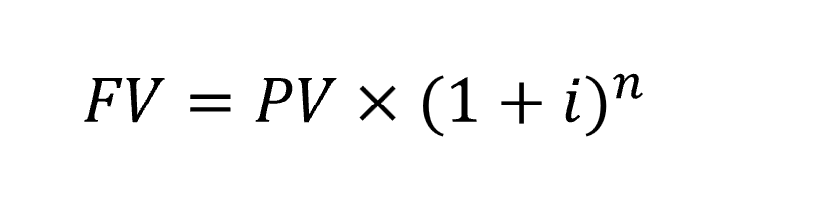
Where:
- FV = balance at the end of the period (after n periods)
- PV = initial principal at the beginning of the period
- i = interest rate
- n = number of periods
- the expression (1+i)n is called the compounding factor
With compound interest, we calculate the future value of a one-time investment over a given period, where the compounding factor represents the expression (1+i)n**.
Calculating Future Value Using the Compounding Factor – Example
Problem Statement: What will be the balance of our term deposit after 5 years if we deposit 100,000 USD and the interest rate is 2%?
Solution:
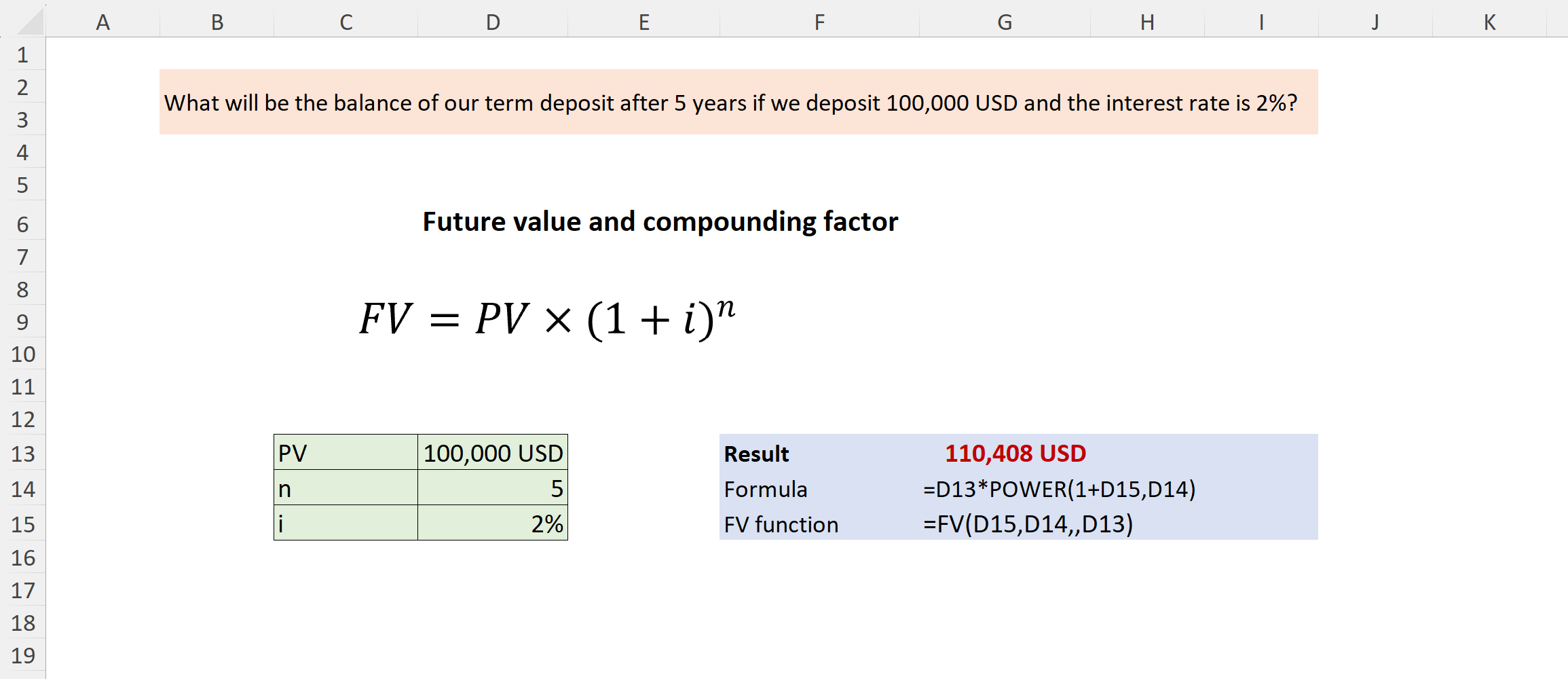
For those who prefer a quicker method, in Excel you can simply use the =FV function and get the same result:
=FV(2%,5,,100000)
>> Please download this excel with example so you cas practise